



In recent months, data center construction has been increasingly constrained by the emergence of hundreds of legal barriers put in place by municipalities, counties, and even entire states across the country. FactSet recently summarized the nature, length, characteristics, and geographical dispersion of these barriers and examined the likely impact on power demand and capital expenditures for domestic utilities. The full report and dataset are now available on the FactSet Workstation, with the dataset to be updated on a quarterly basis.
Generally, the imminent impact on utilities is the timing of construction and load realization:
Locus of Risk: The following chart indicates which parent utilities are most exposed to data center load being delayed or turned away.
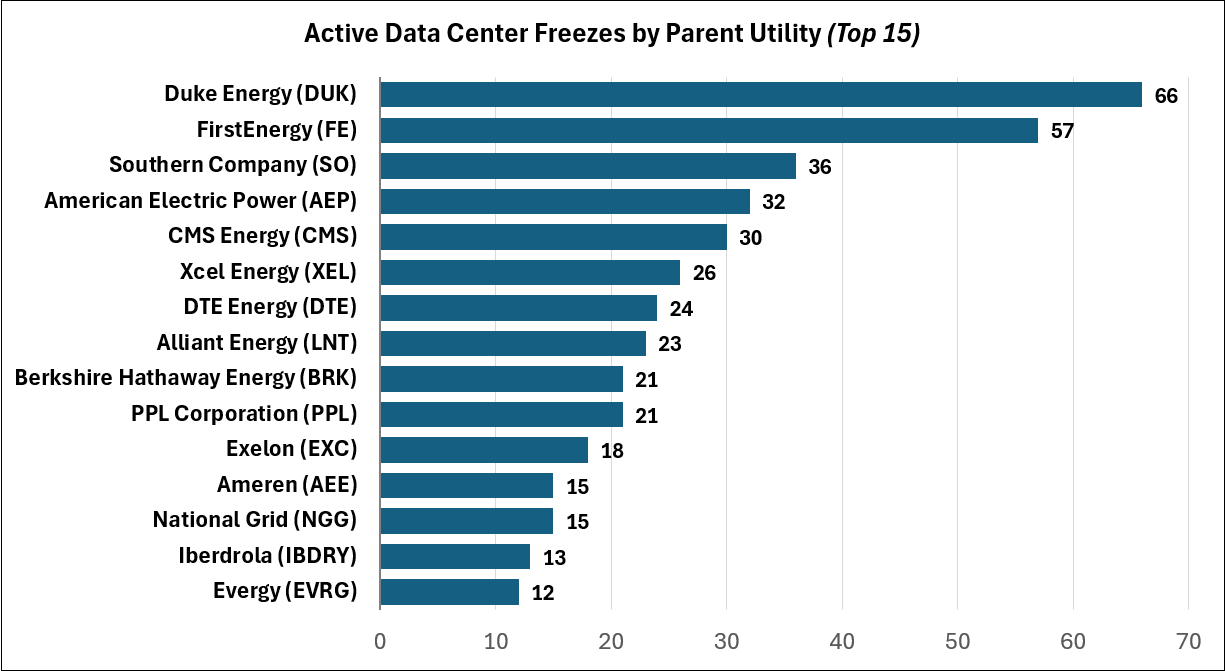
Source: FactSet
Until recently, a utility's large-load forecast derived from customer commitments: signed service requests and applications for a position in interconnection queues. But these inputs no longer reveal when, or whether, large load is likely to energize. That outcome is now significantly influenced by county zoning boards and city councils. Moratoria buy time to write permanent rules, and those rules will affect how fast, where, and at what cost projects are built.
In sum, the practical effects of current moratoria are:
A widening gap between a utility’s announced pipeline of large load vs. the appearance of actual revenue-producing large load. This gap manifests as capex timing risk: large load forecasts may convert at a lower, less predictable rate than a utility’s economic development pipeline implies.
Added uncertainty to a utility’s forecast of anticipated data center customer additions. Siting risk—being an additional source of doubt about when and where data centers get built—is one of several forces making data center load forecasts harder to defend.
Be sure to check back in for more Energy Market Insights covering the everchanging utility regulatory environment.
This blog post is for informational purposes only. The information contained in this blog post is not legal, tax, or investment advice. FactSet does not endorse or recommend any investments and assumes no liability for any consequence relating directly or indirectly to any action or inaction taken based on the information contained in this article.

2026 Election Results Could Signal Changes in Utility Regulation
The midterm election saw Democrats achieve majorities in both the House and Senate, bringing potential impacts to the entire U.S....
Modeling Iron-Air Battery Arbitrage in U.S. Power Markets
In this Insight, we investigate the potential use and revenue of iron-air batteries within power markets.
Balancing Hyperscale Demand and Ratepayer Protections in Wyoming
Wyoming’s pitch to hyperscale tech developers has long rested on low-cost industrial power, available rural land, and an...
The information contained in this article is not investment advice. FactSet does not endorse or recommend any investments and assumes no liability for any consequence relating directly or indirectly to any action or inaction taken based on the information contained in this article.

 Post Comment